
Sep 30, 2026
Jul 31, 2026
Share on :
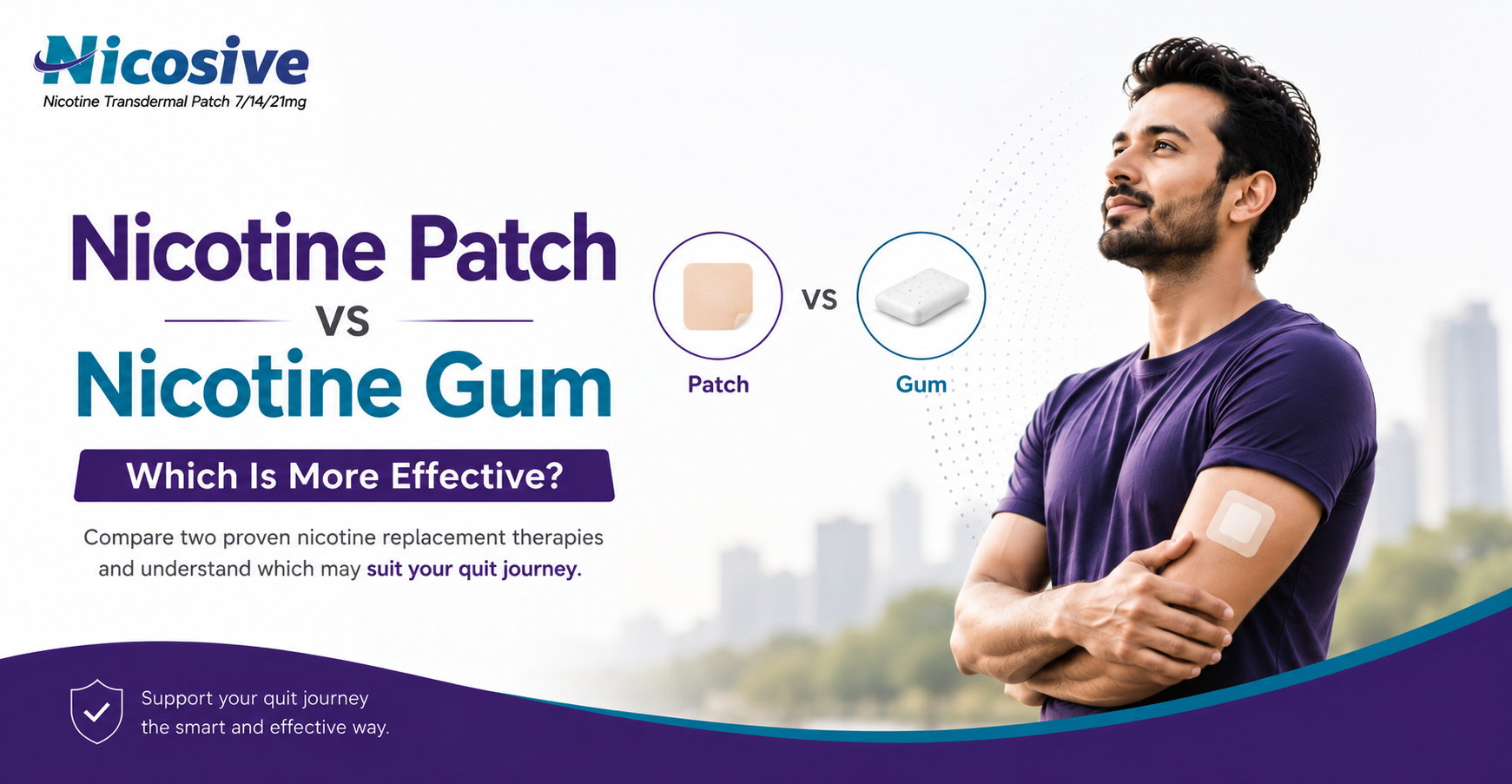
Quitting smoking is different for every person. Some smokers struggle with constant cravings throughout the day, while others find certain situations - like stress, tea breaks, or social gatherings - the hardest to manage.
That’s why nicotine replacement therapies are designed in different forms. Two of the most commonly used options are nicotine patches and nicotine gum. Both are used as smoking cessation treatments, but they work in different ways and suit different lifestyles.
Some people need constant, background support that requires no thought - a patch you apply once and forget for three days. Others need something fast and on-demand for the moments a craving hits hard. These are different tools built for different problems.
This guide compares both honestly - how they work, who each suits, what the evidence says, and which one gives you the better chance of actually following through.
Nicotine Replacement Therapy works by giving the body a controlled source of nicotine - enough to ease the withdrawal, not enough to maintain the full dependency - while you break the habit layer by layer.
Unlike cigarettes, NRT delivers only nicotine - none of the 7,000 other chemicals that cigarettes carry.
Common nicotine replacement methods include:
A nicotine patch is placed on the skin and works through the skin - nicotine passes through the dermal layers directly into the bloodstream, delivering a steady, controlled amount over an extended period.
This steady nicotine delivery helps:
Unlike most nicotine patches that need daily replacement, some patches - like Nicosive - are designed to last 72 hours. One patch, three days of consistent support. For a person managing a busy life, that difference matters.
Applied once - and depending on the patch, it works for up to 72 hours. No remembering to take it at noon. No carrying anything. It works while you sleep, work, and move through your day.
The steady nicotine release means no peaks and crashes. Instead of your nicotine level spiking when you smoke and then dropping - triggering another craving - the patch holds it stable. That stability is what makes withdrawal manageable.
If you smoke more than 10 cigarettes a day - your body has built a near-constant nicotine dependence. The patch addresses that baseline. It does not spike and drop like a cigarette. It holds the floor steady.
Use nicotine replacement products only under medical guidance.
Nicotine gum delivers nicotine through the mucous membrane of the mouth - the inner cheek absorbs it directly as you chew and hold the gum in place.
Unlike patches, gum reaches the bloodstream faster than a patch - typically within 20-30 minutes of use - making it the go-to option when a craving arrives without warning.
Many smokers use nicotine gum during:
When a craving hits without warning - before a meeting, during an argument, stuck in traffic - gum provides relief within minutes rather than relying on a baseline that is already in your bloodstream.
Users can take gum only when needed.
For smokers whose habit is deeply tied to the physical act - the hand-to-mouth motion, having something to do - gum provides a partial substitute for that behaviour. It does not replace the psychological work, but it reduces the sensory gap.
| Feature | Nicotine Patch | Nicotine Gum |
|---|---|---|
| Nicotine Delivery | Slow and steady | Faster and short-term |
| Usage | Once every 3 days (72-hour patches) | 8-12 pieces daily as needed |
| Best For | Constant cravings | Sudden cravings |
| Convenience | Very easy | Requires repeated use |
| Oral Habit Support | No | Yes |
| Common Side Effects | Skin irritation | Mouth discomfort |
| Duration per use | Up to 72 hours | 20-30 minutes |
The honest answer: for most heavy, constant smokers, the patch provides more reliable baseline support. For occasional smokers or those with specific trigger moments, gum offers more precision. And for some - both together, under medical guidance, works better than either alone.
If you are not sure which fits your pattern, the most useful question to ask is this: are your cravings constant throughout the day, or do they spike at specific moments? Constant cravings - patch. Specific triggers - gum. Both - combination therapy.
Both nicotine patches and nicotine gum are recognised as effective smoking cessation treatments when used properly.
According to a Cochrane Review of over 150 trials, nicotine patches increase the likelihood of quitting successfully by 50-70% compared to attempting to quit without support. Nicotine gum shows similar effectiveness when used consistently and correctly.
The transdermal delivery mechanism bypasses the digestive system entirely - nicotine enters the bloodstream directly through the skin at a controlled, steady rate. This eliminates the peaks and troughs that make withdrawal so difficult to manage.
Nicotine gum offers quicker relief during sudden cravings or stressful situations.
Combination NRT - using a patch for baseline nicotine and gum for sudden cravings - is supported by clinical evidence and recommended in Indian cessation guidelines. Research shows this approach can nearly double quit rates compared to using either alone.
The patch manages the constant, background craving. The gum handles the moments the patch alone cannot - the sudden spike, the stressful meeting, the social situation. Together, they cover both dimensions of nicotine dependence: physical and situational.
This combination should only be used under medical guidance to ensure appropriate dosage.
All nicotine replacement therapy - including patches, gum, or combination use - should be started and managed under the guidance of a qualified healthcare professional. Dosage, duration, and suitability vary based on individual medical history, nicotine dependence, and health conditions. Do not self-medicate.
Cravings are one of the biggest challenges smokers face after quitting. They can appear unexpectedly during routines, emotional stress, or social situations connected to smoking habits.
NRT handles the chemistry. Habits handle everything else. Both matter - and neither is sufficient without the other.
For many smokers, cigarettes become connected to:
Recognising these patterns early can help people prepare healthier alternatives and reduce the urge to relapse.
Each craving lasts an average of three to five minutes. That is not a metaphor - it is a measurable window. Outlasting one craving builds the confidence to outlast the next. And as the weeks pass, those windows get shorter, less frequent, and easier to close.
Is nicotine patch or gum more effective?
For constant, heavy smokers, patches generally provide more reliable baseline support. For occasional or trigger-based cravings, gum offers faster targeted relief. Many people achieve the best results using both under medical guidance.
Which works faster - nicotine patch or gum?
Nicotine gum usually provides faster craving relief, while patches offer steady support throughout the day.
Can nicotine patches reduce withdrawal symptoms?
Yes. Nicotine patches may help reduce cravings and withdrawal symptoms by supplying controlled nicotine levels.
Does nicotine gum help with stress cravings?
Many smokers use nicotine gum during stressful situations or sudden cravings.
Are nicotine replacement products safer than smoking?
Yes. NRT products deliver only nicotine - without the tar, carbon monoxide, and carcinogens that cigarettes produce. Nicotine itself carries some cardiovascular risk, which is why NRT should be used under medical guidance, particularly for people with heart conditions.
Can I combine nicotine gum and patches?
Combination therapy should only be used under medical supervision.
How long should nicotine replacement therapy be used?
Standard guidelines recommend 8-12 weeks minimum for most NRT programmes. A typical step-down approach starts with a higher-strength patch, moves to mid-strength, then a lower dose before stopping. Your doctor will advise the right duration and schedule for your level of dependence.
Patch or gum - the right answer is the one that matches the shape of your addiction.
If your craving is constant - present when you wake up, all through the day, before you sleep - the patch is built for that. A steady baseline, no decisions required, working quietly in the background.
If your craving comes in waves - triggered by stress, a chai, a work break, a social moment - gum gives you precision when you need it most.
And if it is both - which is more common than people admit - combination therapy under medical guidance is the most evidence-supported route available.
One thing the evidence is clear on: structured support, whatever form it takes, significantly outperforms willpower alone. The decision to use NRT is not a sign of weakness. It is a sign of choosing the right tool for the job.
Talk to your doctor about which strength, which form, and which duration is right for your quit plan.
[This article is part of a patient awareness initiative by Nicosive, Nicotine Transdermal Patch 7/14/21mg, from Hetero Healthcare. Visit nicosive.com for more on structured smoking cessation.]
1. Hartmann-Boyce J et al. Nicotine replacement therapy versus control for smoking cessation. Cochrane Database of Systematic Reviews. 2018.
2. NHS Better Health. Nicotine replacement therapy (NRT). NHS England. 2023.
3. WHO Framework Convention on Tobacco Control. Guidelines for tobacco cessation.
4. Ministry of Health & Family Welfare. National List of Essential Medicines (NLEM) 2022 - NRT inclusion.
5. Fiore MC et al. Treating Tobacco Use and Dependence. US Clinical Practice Guidelines. 2008."
Continue Reading
Hello Aravind Useing Sticky Here Testing scroll
Hello Aravind Useing Sticky Here Testing scroll
Hello Aravind Useing Sticky Here Testing scroll
Hello Aravind Useing Sticky Here Testing scroll
Hello Aravind Useing Sticky Here Testing scroll
Hello Aravind Useing Sticky Here Testing scroll
Hello Aravind Useing Sticky Here Testing scroll
Hello Aravind Useing Sticky Here Testing scroll
Hello Aravind Useing Sticky Here Testing scroll
Hello Aravind Useing Sticky Here Testing scroll
Hello Aravind Useing Sticky Here Testing scroll
Hello Aravind Useing Sticky Here Testing scroll
Hello Aravind Useing Sticky Here Testing scroll
Hello Aravind Useing Sticky Here Testing scroll
Hello Aravind Useing Sticky Here Testing scroll
Hello Aravind Useing Sticky Here Testing scroll
Hello Aravind Useing Sticky Here Testing scroll
Hello Aravind Useing Sticky Here Testing scroll
Hello Aravind Useing Sticky Here Testing scroll
Hello Aravind Useing Sticky Here Testing scroll
Hello Aravind Useing Sticky Here Testing scroll
Hello Aravind Useing Sticky Here Testing scroll
Hello Aravind Useing Sticky Here Testing scroll
Hello Aravind Useing Sticky Here Testing scroll
Hello Aravind Useing Sticky Here Testing scroll
Hello Aravind Useing Sticky Here Testing scroll
Hello Aravind Useing Sticky Here Testing scroll
Hello Aravind Useing Sticky Here Testing scroll
Hello Aravind Useing Sticky Here Testing scroll
Hello Aravind Useing Sticky Here Testing scroll

Nicosive Nicotine Transdermal Patch. A structured, step-down approach to smoking cessation with 24-hour controlled nicotine delivery.
Quick Links
Nicosive Nicotine Transdermal Patch. A structured, step-down approach to smoking cessation with 24-hour controlled nicotine delivery.